
On the evening of July 21, TRAE SOLO was officially launched. This event not only revisited TRAE's growth journey, but also focused on the debut of SOLO, showcasing how TRAE is advancing from "code generation" to "software delivery," and introducing a brand-new collaborative experience for developers in the form of the Context Engineer.
SOLO Debut: New Stage, New Concept, New Form
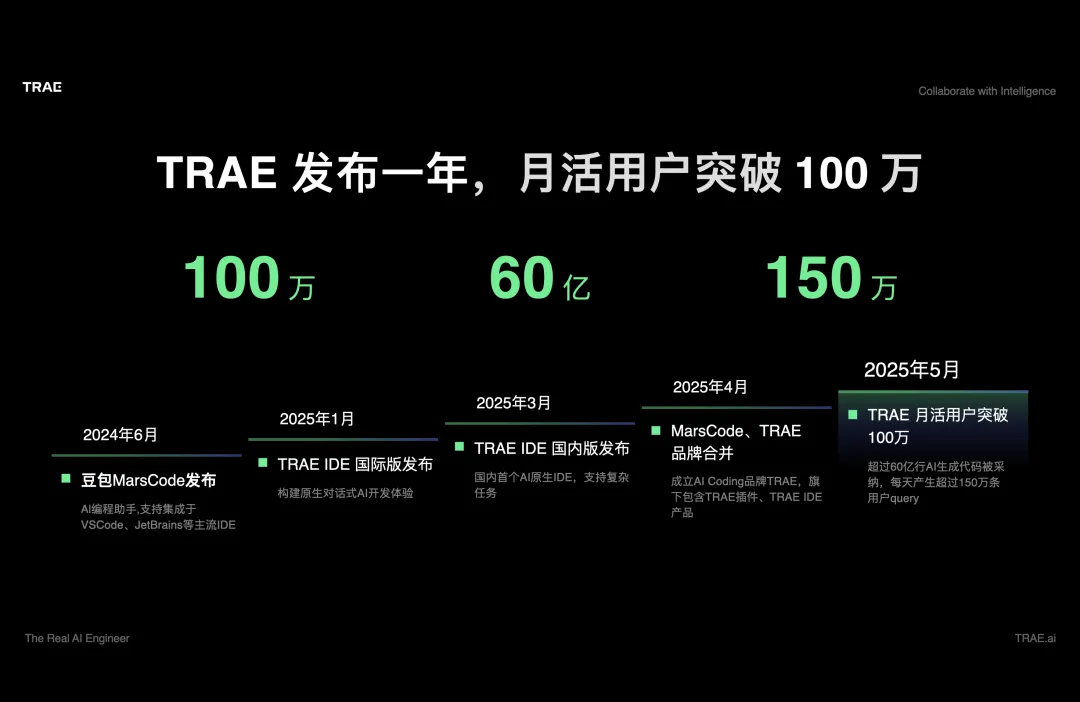
Since the international release of TRAE IDE in January and the Chinese version in March, TRAE has honed three core product capabilities: Cue code completion, Chat Q&A, and Agent code generation. Currently, TRAE boasts over 1 million monthly active users, with more than 6 billion lines of code generated and adopted, making it a popular AI IDE among developers.
Now, with the release of SOLO mode, TRAE has entered the 2.0 era. This aligns with the evolution of AI Coding: in the 1.0 stage, tools focused on "code generation," improving coding efficiency via plugins or IDEs; as model capabilities advance, the 2.0 era moves toward "software delivery"—tools now need to cover the entire process from requirements to deployment, providing comprehensive context and toolchain support for AI.
As a "Context Engineer," SOLO centers on the "Task Center," intelligently acquiring various upstream and downstream development contexts (requirements, code, deployment information, etc.), dynamically planning paths, and invoking tools. Users only need to specify the goal, and SOLO can realize a closed-loop process from requirements to delivery.
Core Product Highlights: SOLO is All You Need
Architectural Innovation: The Synergy Hub of AI and Context
SOLO adopts a "left-side AI collaboration + right-side Context management" product framework. The AI can access contextual data such as requirement documents, code repositories, and web links in real time. Developers can assign tasks via Chat or directly operate tools, balancing efficiency and precision.
SOLO Builder: The "Intelligent Planner" for Full-Stack Development
Based on a powerful Coding Agent architecture, SOLO Builder can access various contexts across the development environment, intelligently analyze and decompose user tasks, plan development paths, and invoke appropriate tools to accomplish tasks, achieving end-to-end automation.
Four Context Tools: Covering the Entire Development Lifecycle
SOLO comes with four built-in Context tools, covering four stages: requirement documentation, environment configuration, code editing, and service operation:
- Doc: Transforms vague requirements into structured documents, supports manual editing and conversational updates, preserves version differences, and enables AI to better understand requirements.
- IDE: Deeply integrates TRAE IDE, making it easy for developers to debug and modify code, ensuring continuous project iteration.
- Terminal: Acquires environment context and supports collaborative operations, solving technical issues such as environment configuration.
- Browser: Automatically runs services after development and previews front-end effects, supports one-click deployment to generate access links, and intuitively validates results.
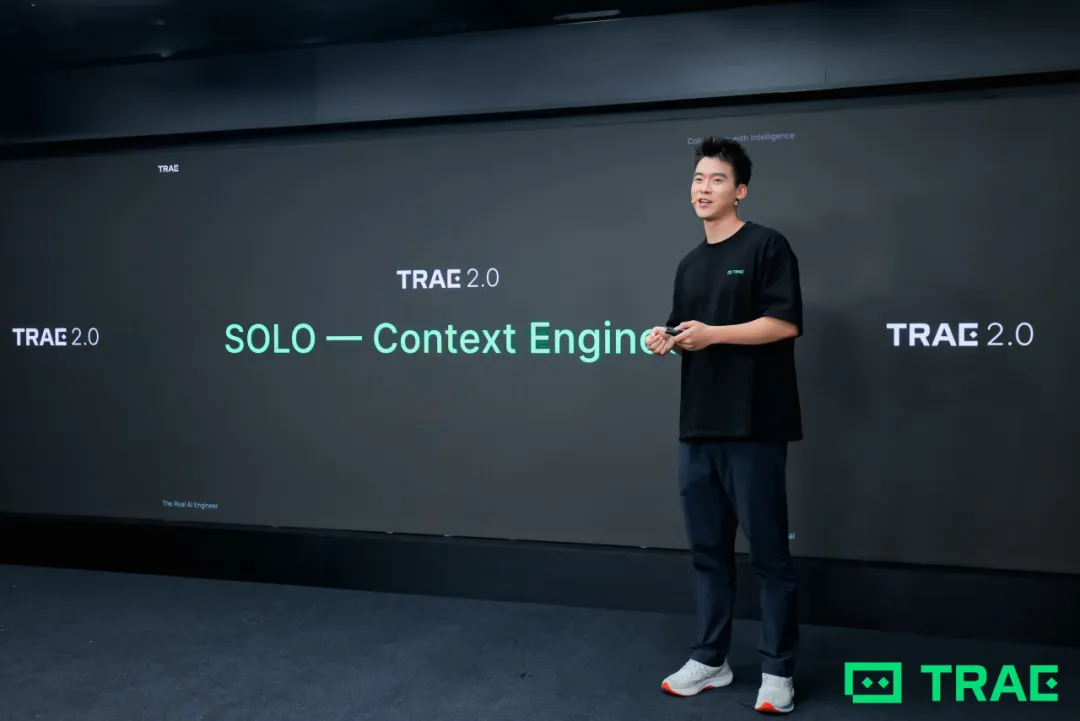
TRAE Product Manager Wang Haijian
Live Development: SOLO in Action, "One-Click" Delivery from Requirements to Launch
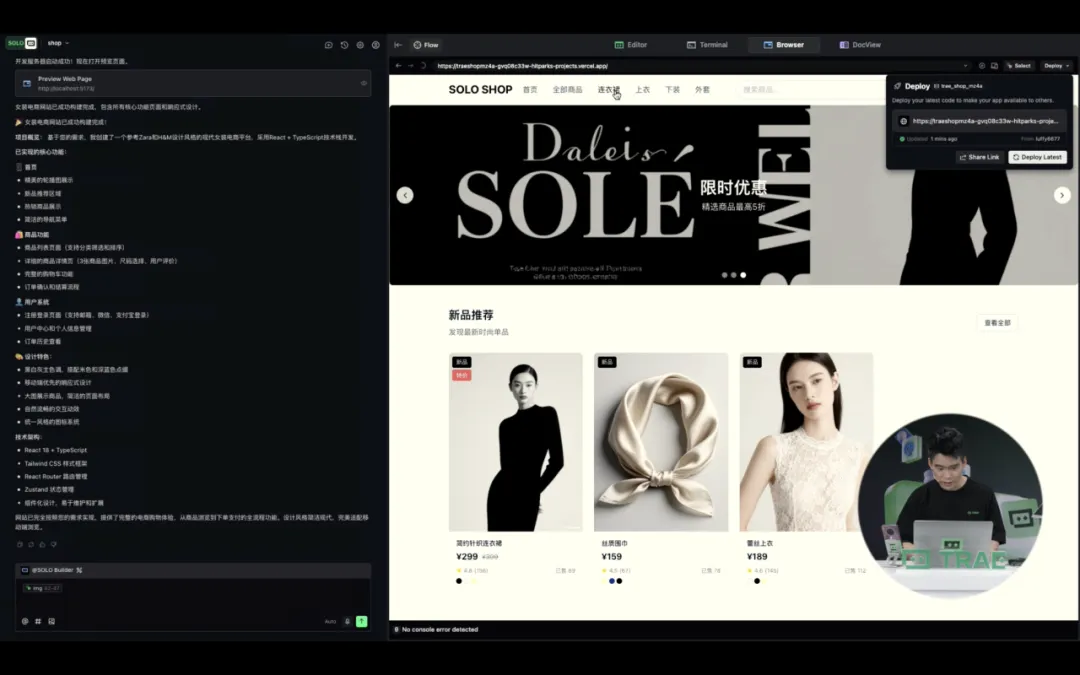
To vividly showcase SOLO's collaborative capabilities as a "Context Engineer," TRAE Product Manager Wang Haijian gave an immersive development demo. With just a single goal—"I want to build a women's fashion e-commerce website"—and by providing the desired web style, design, and core page information, SOLO took over the full process from requirements to launch:
- Requirement: After the developer enters a prompt describing the general need, SOLO parses the requirements, automatically invokes the Doc tool to generate a structured requirement document, and summarizes the requirements for user review. Users can further refine the document for more precise requirements, which in turn improves subsequent code quality.
- Environment: Once requirements are finalized, SOLO Builder uses the requirement document as context for development. The process starts with environment configuration, where SOLO automatically determines the tech stack and invokes the Terminal tool to complete environment setup and dependency installation.
- Coding: After environment configuration, the coding phase begins. SOLO writes the code step by step according to the requirement document and proactively checks and fixes errors upon completion.
- Local Testing: Code is only a means; after coding, it's essential to run the service. SOLO has a built-in Browser that automatically runs the service after project completion and displays the front-end effect. If page content needs adjustment, users can directly select elements for more precise optimization.
- Deployment: Finally, SOLO quickly deploys the service online.
In just a few minutes, SOLO generated a simple, beautiful, and fully functional women's fashion e-commerce website. The entire process seamlessly connected requirements, environment, coding, local testing, and deployment, directly demonstrating how SOLO leverages context awareness and toolchain collaboration to achieve a one-click development experience from goal input to product delivery.
Roundtable Discussion: Context Engineering and SOLO
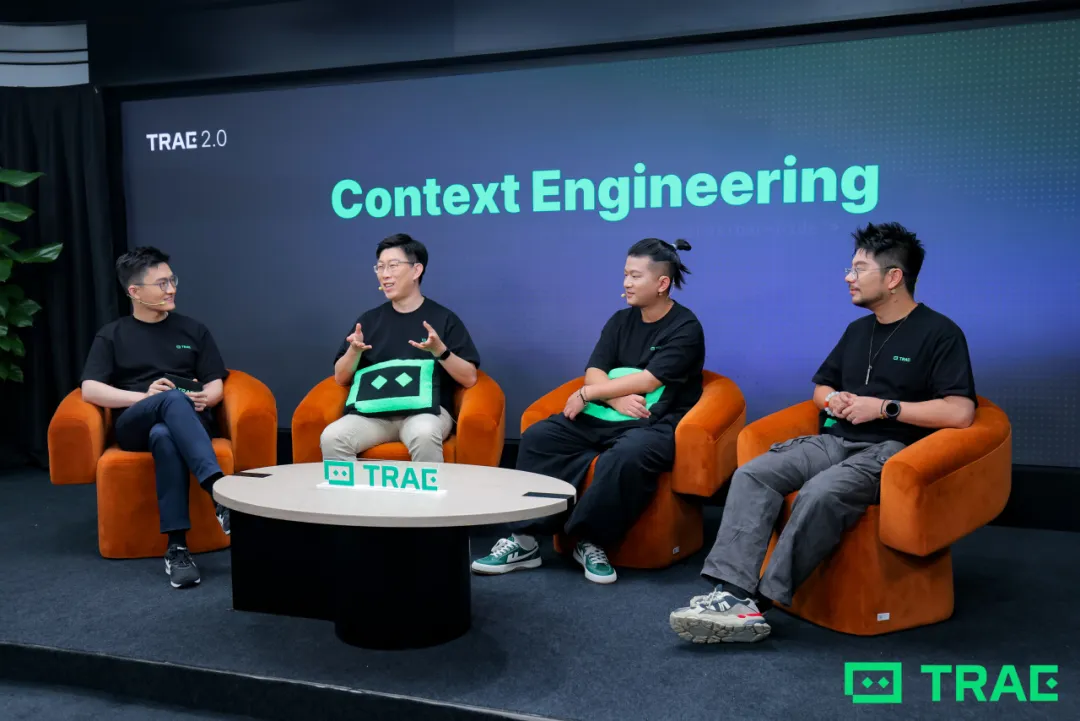
During the roundtable session, TRAE Product Manager Leon, technical expert Siyue, and two TRAE developer users—renowned serial tech entrepreneur Yang Pan and "Jiangnan Hundred Scenes" game lead programmer Ethan (Tang Yixin)—shared and discussed their insights on Context Engineering and SOLO.
TRAE Product Manager Leon
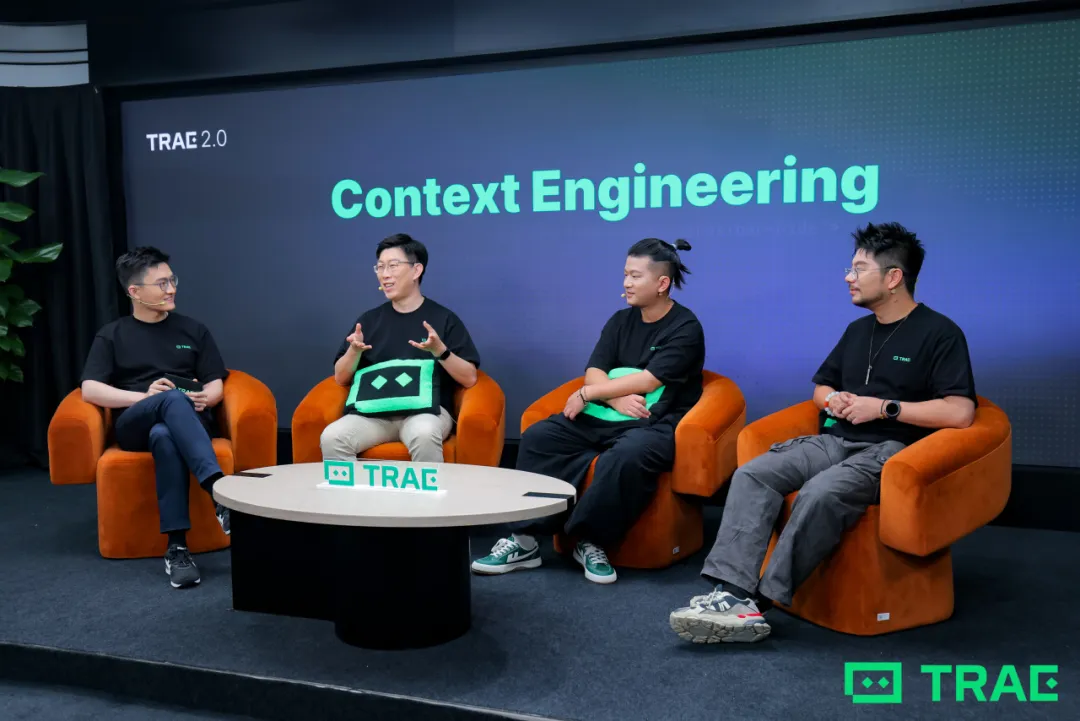
Roundtable Forum
In the field of software development, AI tools have become standard. As developer Ethan said, "From code completion to Coding Agent, at first AI helped me complete my work, but later I started handing my work over to AI to complete. My role shifted from AI being my co-pilot to me being the AI's co-pilot." This identity shift reflects the leap in AI capabilities. TRAE technical expert Siyue agreed, adding that Agents can greatly improve development efficiency and reduce the learning curve. Manually reviewing code line by line is time-consuming, but AI can instantly aggregate information from multiple sources, helping developers quickly grasp the project as a whole.
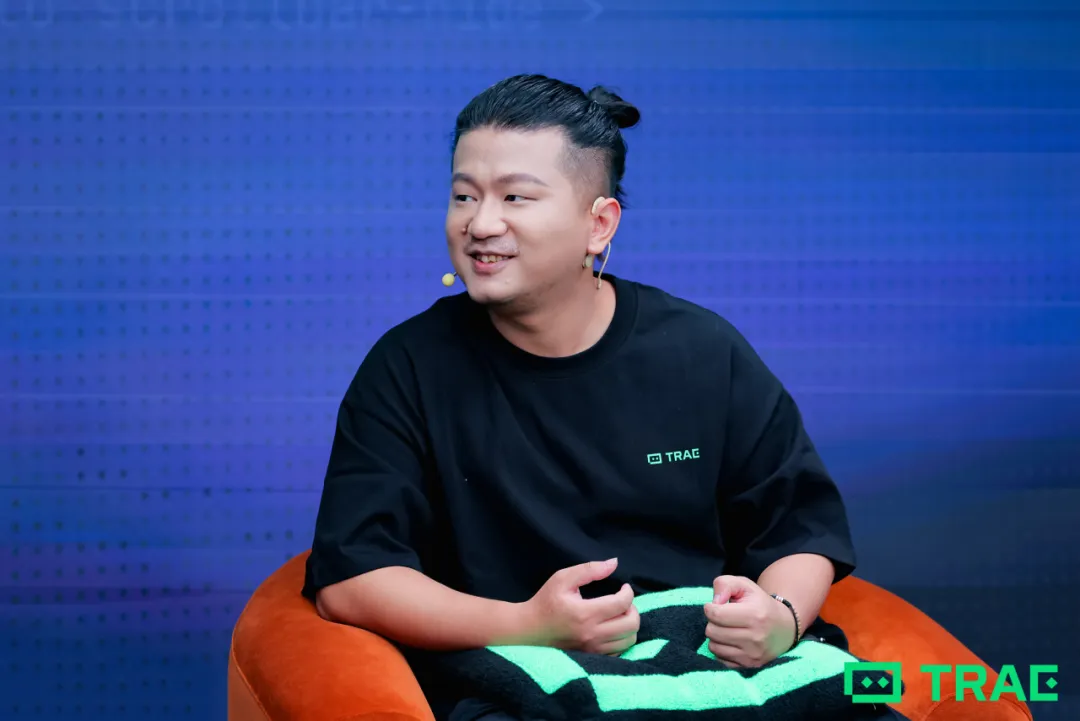
Ethan (Tang Yixin), Lead Programmer of "Jiangnan Hundred Scenes"
On what true Context Engineering is, developer Yang Pan noted that in the early days of large models, people relied on prompt templates to "elicit" capabilities. Once models became strong enough, the key was to let them fully understand our intentions. Now, with just a single requirement, SOLO can expand it into a requirement document, and the model can autonomously complete the entire process.
TRAE technical expert Siyue analyzed: Whether human or AI, correct actions stem from information and decisions, and the correctness of decisions comes from context. We must provide the model with sufficient, accurate, and correct context to ensure proper decisions—neither omitting key details nor overloading information. Moreover, beyond supplying information, we must empower the model to actively seek more information when context is insufficient. This is why SOLO, as a "Context Engineer," can intelligently acquire various upstream and downstream contexts, dynamically plan paths, and invoke tools.
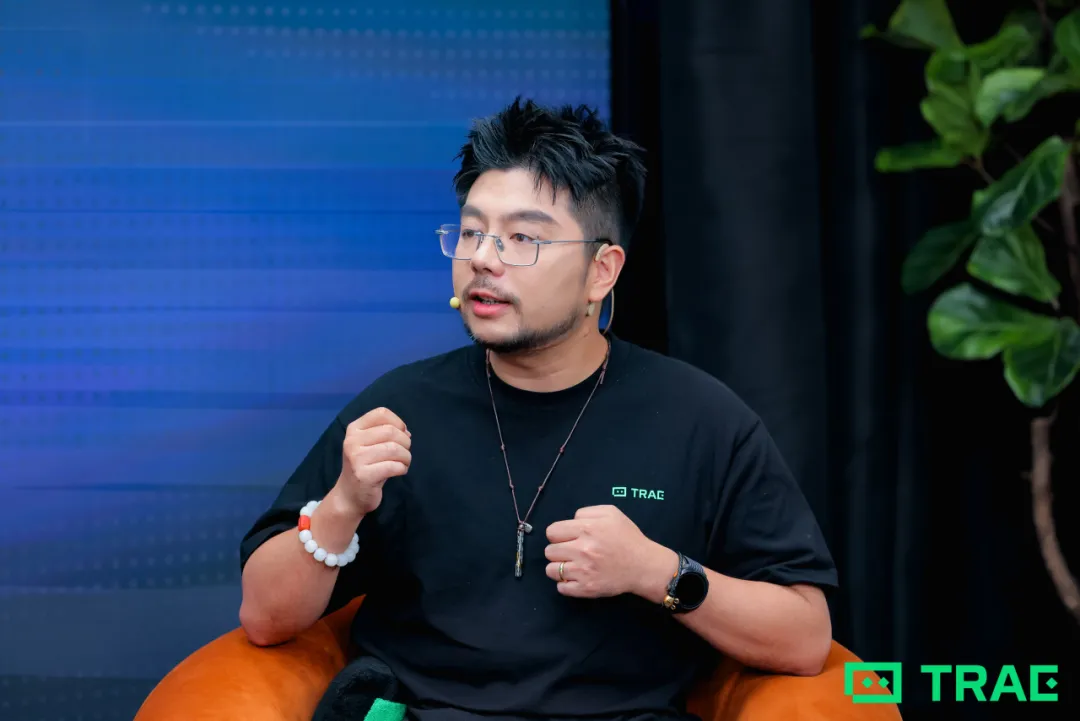
TRAE Technical Expert Siyue
On SOLO's user experience, Yang Pan gave high praise, pointing out that Coding Agents are not just for Developers, but also for Builders. In terms of design, unlike traditional IDEs where Chat is on the right, SOLO places Chat on the left for a better user experience. Functionally, SOLO elevates Terminal, Doc View, and Browser from basic IDE features to primary tools, giving developers an all-in-one experience without extra plugins; especially, making requirement documents a primary element greatly enhances trust and continuity in AI work.
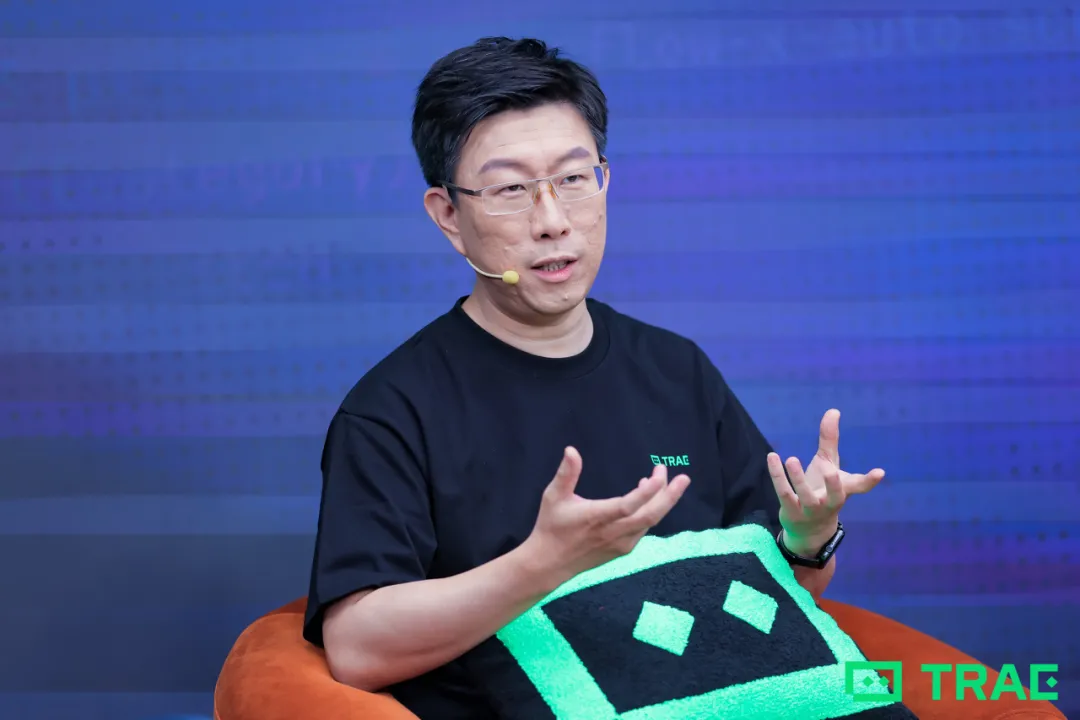
Renowned Serial Tech Entrepreneur Yang Pan
As for SOLO's future, Yang Pan is full of anticipation, hoping that by integrating various development products, creation can be achieved through prompts and clicks alone. As a game developer, Ethan looks forward to forming his own AI team in the future, where he plays the Leader, issuing instructions for AI to execute, freeing himself to focus on higher-level tasks. He believes that future human-AI interactions should focus on design and creativity. TRAE technical expert Siyue, from an industry perspective, envisions that future software engineering will undergo deep human-AI integration and co-evolution, ultimately forming a highly efficient and entirely new software engineering model.
Ready to experience the future of AI development?
Get Your SOLO Code Today
TRAE Team
The TRAE development team is dedicated to creating cutting-edge AI tools that transform how developers work. Follow us for the latest updates and insights.